

The AEC (Architecture, Engineering and Construction) industry has transformed a lot in the past couple of decades. One of the major changes that this industry has seen is the use of scan to BIM services. With this service, we can create an identical digital twin of the building, so that we can precisely see what our actual finished work would be. However, a common question that every project manager and architect thinks about is how accurate these digital twin models are?
No two construction projects are the same. That’s why every single construction project requires a different approach to ensure its accuracy without raising the cost. Too much precision can lead to heavy data files and high cost, and too little precision could result in a useless model for construction. The project’s success depends on understanding the specific details of scan to bim modeling services because this knowledge helps us to establish achievable project goals.
Understanding the Two Stages of Accuracy
To understand the final output, one must distinguish between the two distinct phases of the point cloud to bim workflow.
Measured Accuracy (The Scan)
Measured accuracy is the precision of the hardware used. The terrestrial laser scanners produce millions of points during the 3D Scanning BIM process to create a “point cloud,” which is used to scan the environment. Modern scanners achieve high accuracy by creating measurements that have an error margin of less than 2 millimeters. The stage shows the actual reality of the physical environment.
Represented Accuracy (The Model)
This is the stage where human intervention is required. The process of Scan to BIM conversion services includes taking the created raw point cloud and 3D elements (Walls, pipes and beams) into software applications like Revit. The “Represented Accuracy” describes how close the modeled surface matches the BIM point cloud. Even if the produced scan is perfect, it still has a tolerance of 10mm.
What Accuracy Should You Actually Expect?
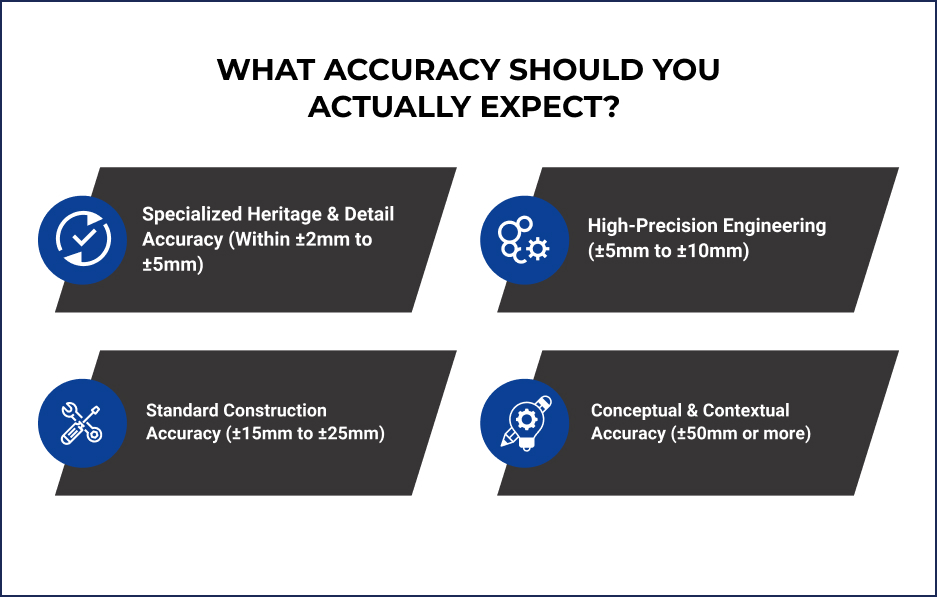
Every project is different, so they also require a different level of accuracy. When it comes to laser scan to BIM services, professionals categorize these accuracy levels into four tiers:
Specialized Heritage & Detail Accuracy (Within ±2mm to ±5mm)
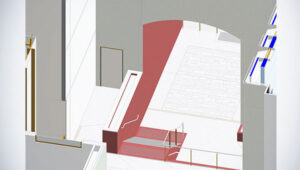
It takes a different approach to create scan to BIM models for heritage or old buildings. This is because old buildings often lean slightly and their floors also sag over time. So, if we use scan to BIM Revit software to make everything look perfect or brand new, we would lose the real essence and history of the building.
To understand how digital workflows extend beyond restoration projects, read our blog, The Role of BIM in Streamlining Facility Management and Operations, and discover how accurate data improves long-term building performance.
High-Precision Engineering (±5mm to ±10mm)
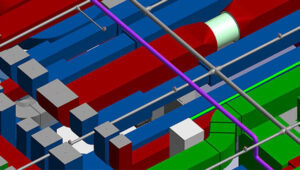
There’s no room for error when we are dealing with complex MEP (Mechanical, Electrical and Plumbing) systems, like heavy machinery, a ceiling full of tangled pipes or steel beams. If the 3D point cloud to BIM model is different by even an inch, we won’t be able to install the utility objects inside the building correctly or at all.
By using a point cloud scan to BIM, professionals make sure that the digital model is accurate up to a 5mm to 10mm margin of error. With this margin of error, they ensure that every component of the utility objects fits the first time perfectly, which saves them from expensive mistakes during construction.
Standard Construction Accuracy (±15mm to ±25mm)
In BIM point cloud The industry standard for architectural renovations and fit-outs ranges between 15mm and 25mm. This range is sufficient for interior design, space planning and general facility management where millimeter-precision is not important to maintain the structural integrity.
Conceptual & Contextual Accuracy (±50mm or more)
There are also many parts in a building that do not require as high a precision level as is required in other components of the same building. When designing the general shapes of the surrounding buildings or the basic slope of the ground using scan to bim modeling services, being highly precise would be a waste of money. So, designing a ‘approximate’ model is fine because it is easy to create, and, more importantly, its digital files take up less space, so they don’t slow down or crash the computer.
Accuracy by Building Part
Accuracy also depends on exactly which part of the building you are looking at:
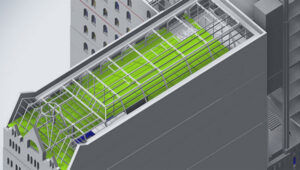
Large Structures: In reality, a 50-meter-long wall is rarely perfectly straight. It usually bows or curves a little. So, while designing the model, a BIM professional decides whether he should be drawing it perfectly straight (which is easier to design) or he should follow the actual curve (which is more accurate).
Pipes and Wires (MEP): A Scan to BIM Services provider should be very careful while designing the MEP. If the designed pipe models are different from the actual pipe locations by more than one inch, it will result in an operational failure during construction. The digital scan of these small pipes shows them ‘blurry,’ which makes them difficult to get right.
To better understand how integrated system planning prevents costly on-site conflicts, explore our detailed guide on Why MEP Coordination Is Important for Clash-Free BIM Models.
Old Buildings (Renovations): The architectural components of old structures and industrial buildings are not precisely 90-degree aligned. Rather, they develop numerous angular deviations, like floor sagging and wall tilting. A reliable scan to bim services provider maintains complete building accuracy by displaying building defects in their original state instead of presenting everything as perfectly symmetrical.
Key Factors Affecting Accuracy
There are several factors that can affect the final quality of a BIM Model:
Scanner Limitations: Laser scanners fail to operate properly when they encounter mirrors, glass surfaces and polished metal objects. The laser “bounces” off them in weird ways, which creates “noise” (digital fuzz) and results in gaps, where there should be data.
Errors in Data Processing: To map a whole building, you have to move the scanner to different rooms. The complete building model will appear distorted if the individual scans are not connected perfectly, like a 3D jigsaw puzzle.
Software and Computer Constraints: If a model is too detailed, its massive data size will take up too much space in its storage, making it slow or crash. Some Scan to BIM Services providers take shortcuts and use simple shapes to keep the size of the model smaller, which lowers the accuracy of the model.
Environmental Factors: In laser scan to BIM services, the scanner experiences disturbances from external noise, like the vibrations arises when a heavy truck passes by or when there are strong winds. Due to these small movements, the 3D “photo” becomes less clear and less precise.

How SmartCADD offers utmost accuracy in Scan to BIM Services
Working with such high technical details can result in inaccuracy. That is why you need a BIM partner who has deep expertise in this field. SmartCADD operates as a leading scan to BIM services provider, which delivers precise 3D models that meet the exact requirements of your specific project.
The team achieves accurate results when transforming messy point cloud scan to BIM models through their use of advanced tools and their structured procedures. The team performs complete verification of all walls and pipes by comparing them with the original laser scan data, whether it is for a factory or an office building project.
Their commitment to producing high-quality work enables you to obtain more than an attractive 3D model. With them, you receive a functional digital asset that supports your needs for construction and manufacturing parts and manages your buildings for years to come.
You can seamlessly connect readers to our related guide, How to Hire Experienced Scan to BIM Experts in Australia for Your Project, for deeper insights into selecting the right professionals to ensure accurate, efficient, and high-quality BIM outcomes.
Conclusion
The process of achieving precise scan to BIM model accuracy requires matching technological capabilities with project requirements. You can establish a robust 3D modeling foundation for your construction project by selecting an experienced partner like SmartCADD to help you understand the differences between the raw scan photo and the tracing process, which creates the model.
You should first establish your “Accuracy Level”, which defines your acceptable measurement limitations, before starting your work. Your 3D scanning BIM model will deliver practical value while generating cost savings because it meets all technical requirements for your project.